For about two years now, every retail conference deck has had a slide promising that AI was going to change shopping. Most of us nodded politely and waited for the actual numbers.
Well — they showed up in 2025.
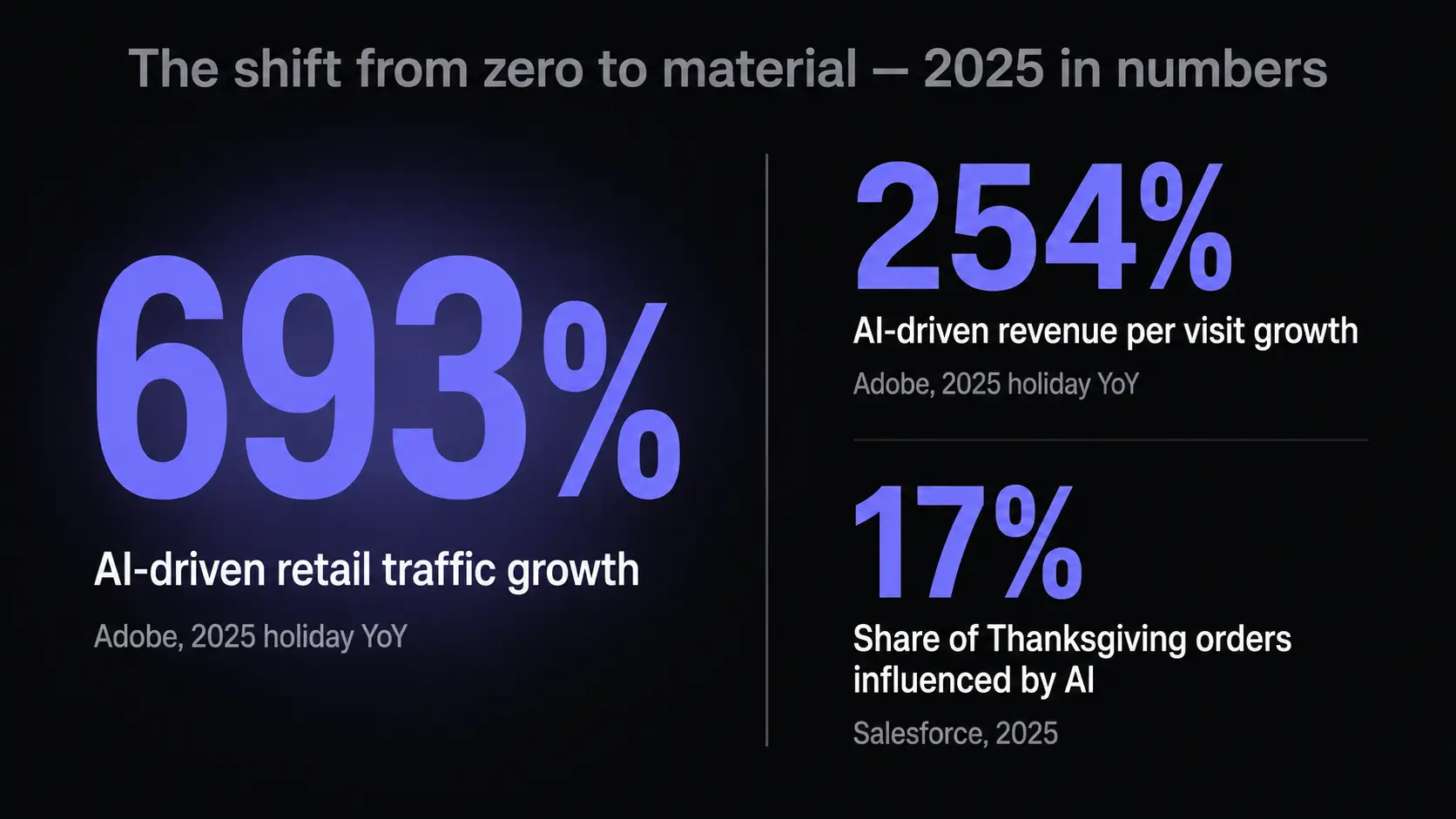
Adobe's analysis of over a trillion US site visits showed AI-driven traffic to retail sites up 693% year-on-year, with retail seeing the biggest jump of any industry. The shoppers behind that traffic converted 31% better than other sources. Revenue per visit was up 254%.
ChatGPT-referred shoppers convert at 11.4% vs 5.3% for organic search, per Similarweb. AI platforms drove 1.1 billion referral visits in June 2025 alone — up 357% year-on-year. Salesforce data showed AI and agents influenced 17% of holiday orders — $13.5 billion in sales — over Thanksgiving weekend.
Zero to material in twelve months. That's not a slow burn. That's the kind of curve you only get once or twice a decade, and missing it has consequences that don't fix themselves.
The adoption is consumer-led, which is the part that should worry you
Bain & Company found 30-45% of US consumers now use generative AI for product research, and 17% planned to start their holiday shopping in ChatGPT or Perplexity before opening a single retailer site. Adobe's consumer survey: 65% feel more confident in their purchase after AI help, and 68% are less likely to return what they bought.
The last number is the one to dwell on for a second. People returning less after using AI tells you the agent is actually doing the matching work — not just deflecting clicks. Returns are the ultimate signal of whether discovery worked.
And now shoppers are training their agents, they're feeding in preferences, sizes, brand histories, budgets, dietary requirements. Every minute they spend doing that makes them less likely to switch tools, and more likely to trust whatever the agent surfaces. The agent's recommendation isn't a suggestion anymore — it's an instruction the shopper has spent weeks teaching it to give.
Aaron Cheris, partner at Bain, put the shift bluntly:
"Agentic AI marks a major shift in retail discovery and loyalty since the rise of search engines."
Aaron Cheris, Partner, Bain & Company
That's a senior Bain partner using "since search engines" as the comparison. Worth pausing on.
Boston Consulting Group's forecast: agentic shopping could account for more than a quarter of ecommerce spending within a few years.
Big brands have a head start. The moat is narrower than it looks.
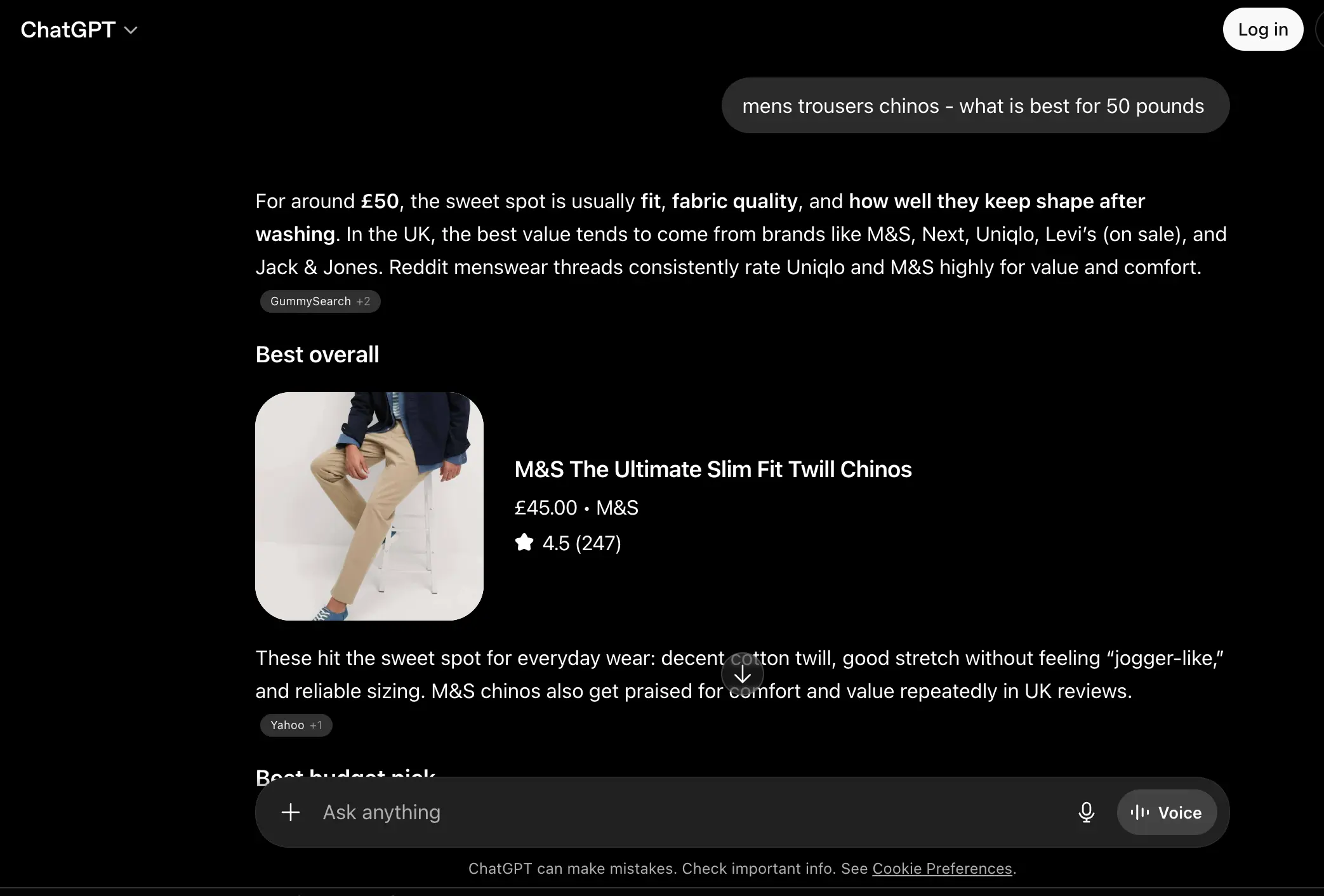
Household names are ahead — and fair play to them, they've earned the position. Huge training-data footprints, established catalogues, increasingly direct platform deals. Walmart's ChatGPT integration drives roughly twice as many new customers as traditional search, and shoppers using Sparky spend 35% more.
But before anyone gets too gloomy about competing with Walmart, Forrester's Emily Pfeiffer was refreshingly honest about where this all actually is:
"Nobody has figured it out, but everyone has FOMO."
Emily Pfeiffer, Principal Analyst, Forrester
That's the thing. Agents don't only surface the biggest brands. They surface the brands they can read. A £40m DTC brand with excellent structured data can compete for specific, intent-led queries that a larger brand with poor data misses.
The unfair advantage in agentic commerce isn't reserved for whoever lobbied OpenAI hardest. It's available to whoever did the data work first.
What "AI-readable" actually means
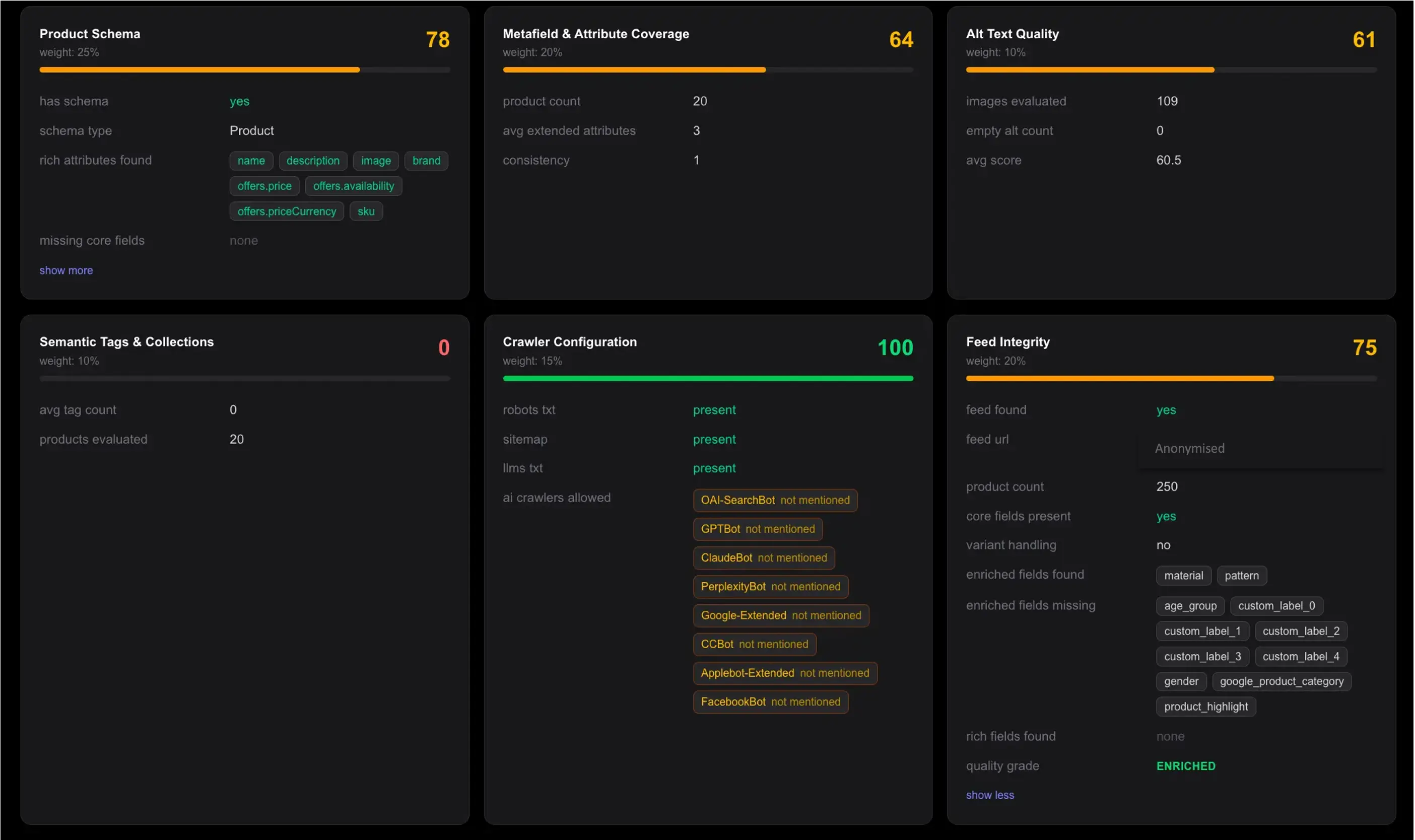
Illustrative report from an earlier version of the Catalign scan, showing six of the seven dimensions we now assess. The metafield score shown here needs direct catalogue access and isn't part of the current scan.
Catalign scans against seven dimensions — the specific signals agents use to decide who to surface.
Product schema. Most brands have schema. Most are missing the bits that matter: price, availability, identifiers (SKU, GTIN, MPN), reviews. An agent can't quote what it can't read, and it will not guess on your behalf.
Metafield and attribute coverage. The attributes beyond title and price. Fashion agents are asked "machine-washable linen workwear." Beauty agents are asked "vegan retinol for sensitive skin." If your catalogue doesn't carry those attributes as structured data, you're not in those conversations. Doesn't matter how perfect the product is.
Alt text quality. Multimodal agents (GPT-4V, Gemini Vision) literally read your images. "Image_4837.jpg" tells them precisely nothing. They move on.
Semantic tags and collections. "Cottagecore floral midi dress for a summer wedding" doesn't match "navy dress." It matches a brand whose products are tagged for style, occasion, fabric, and silhouette. The brand that did that work wins the query, every time.
Crawler configuration. Your robots.txt, sitemap, and the new llms.txt standard. Most mid-tier brands haven't optimised any of it — they're trusting permissive defaults, which is a bit like leaving your front door open and hoping the right guests find their way in.
Feed integrity. AI agents discover through structured feeds, not real-time crawling. A missing or thin feed makes a catalogue genuinely invisible to comparison-shopping queries. Not "under-performing" — invisible.
Application templates. The emerging agent-facing endpoints — Agentic Commerce Protocol manifests and Perplexity's merchant integration. Almost nobody has them yet, which is precisely why they're cheap to win.
The number we keep seeing
Across the 14 UK mid-market fashion brands in our latest study:
The average is 37 out of 100. Not one brand has scored above 47.
Every brand we've scanned grades D or F. That isn't a story about careless catalogues — these brands have invested in ecommerce foundations, and it shows: product schema averages 67 out of 100 and crawler access 86. The collapse is concentrated in the machine-readable layers that never mattered for traditional search. Semantic tags average under 1 out of 100, with only four brands scoring above zero at all, and alt text averages 19.
The gap is targeted, not foundational. Missing feed. Zero semantic tags. Schema that's structured but missing key commerce fields. Alt text written as an afterthought, if at all. The data is usually almost there. It just isn't structured where agents look for it.
Which, honestly, is good news. Fixable problems are the best kind.
What Catalign does
Scan. Seven-dimension diagnostic of any commerce site, graded report in 72 hours. No access, no integration, no setup. You give us a URL; we give you a verdict. Six of the seven dimensions score from public pages; metafield coverage needs direct catalogue access.
Enrich. Full catalogue enrichment across seven dimensions — schema, feed fields, semantic tags, alt text, application templates, metafields, and crawler config including llms.txt. We ship a bundle that drops into your platform, with all enrichments laid out for your team to review and approve before deployment. Under seven days from engagement to deployable bundle — not the six-month consultancy engagement that quietly becomes a year-long one.
Monitor. Re-scan and track as the protocols evolve — OpenAI's Agentic Commerce Protocol, Google's Universal Commerce Protocol, and whatever's coming next that we don't yet have the acronym for.
Why now, not next year
The brands that win the next decade of commerce discovery aren't going to be the ones with the biggest budgets. They're going to be the ones whose data was already structured and discoverable when AI agents matured.
Agentic commerce is a window. Right now it's wide open. Every month, agents accumulate more signal on the brands that moved early. Those brands become the defaults. Defaults compound. By the time a competitor decides to catch up in 2028, they'll be doing the same work — but pushing against an embedded preference for the brands that moved this year.
Same pattern as paid social in 2014. Mobile-first in 2012. SEO in 2008. Brands that acted while the channel was still emerging captured a permanent advantage. The ones who waited until the channel was "proven" spent the next decade trying to claw back ground from rivals who got there first.
And here's the bit that makes this one different: unlike paid social, you can't outspend your way back in. Once your competitors are the trained default in the agent's recommendations, more budget doesn't move you up the list. The recommendation has been made, the preference has been learned, and you weren't in the conversation.
We can have your full catalogue scanned, enriched and shipped in a deployable bundle in under seven days.
Want to know where your business stands? Get in touch.